Venture Up Tabs

Showing posts with label Travel. Show all posts

Monday, September 7, 2015

Why do epic events happen on holidays?

(Evergreen, CO) — What do epic events and holidays have in common? They happen at the same time! Really, have you ever been to the emergency room when it wasn’t a Sunday or the 4th of July? Well, Labor Day weekend is no different. Sometimes it’s worse when the plan starts off so well.


Relying on the dog car, our rusty minivan that never fails, I was heading to our Arizona home from our Minnesota place, where my son, Miles, just graduated in hockey from Shattuck-St. Mary’s. 

Our dogs, Eddy the Bernese, and Shooter, the coyote crossed with a python, were rescued as older pups eight years ago in Flagstaff. Now each dog has a solid sense of self, each choosing what he will eat, what weather is tolerable, and who drives the car. They are the only mountain dogs who prefer winters inside. But then, who wouldn’t during that 10-month span in Minnesota?

The car was packed with gear to drop off in Des Moines for a Venture Up team building event, and some game show stash for a team program in Salt Lake City just days away. The dogs had lots of leg room, but they favor the coiled cobra position, unless pouncing for a snack thrown from the driver they allowed to sit behind the wheel.

There are two seasons in the midwest: winter and road work. Clogged traffic, fatigue and hunger signal our time for a detour. The ride was seamless until hitting a snag in Nebraska. Yippee! An exit. We landed on the cobblestone streets of the Omaha’s Old Market. Since Warren couldn’t do lunch, I settled for carrot cake, my vegetable, at this cool tea shop, below. Does anyone know it? My dog ate the receipt.

Does anyone know the name of this tea shop in Old Market Omaha? My dog ate the receipt.

The visitors center here is already my favorite. Where else would anyone hand over a free pad of street maps in order for a herd of corporate teams to trammel through their town? Venture Up runs a series of Amazing Race events in Omaha as well as other cities. Travel offices everywhere can be stingy with maps, even when mentioning the magic word$$$, “corporate meeting”.

By chance, Venture Up is hosting an Amazing Race in Omaha in a few weeks and we were planning to update the program with new sites in this historic area, so I ended up saving somebody a little leg work. Serendipity!

Public dog parks along the route kept the boys from getting too fussy. Back on the road, the sun lay low as we headed to a hotel in Hastings. When a sign on a Nebraska highway indicates, “Hastings, next exit,” remember that it’s actually 15 miles further away.

Lucky me! I spent the night in the land of Kool Aid. Yup, Kool Aid was invented in Hastings and a museum will tell you all about it.
It was cool and windy the next morning as we took I70, a straight shot to Denver. I thought we’d blitz through the corn fields and head for the hills, but who couldn’t stop at the Pony Express station in Gothenburg, Nebraska? 


The original station, a log cabin now set in a park, no longer processes U.S. mail, although some of us may prefer it over the debt-ridden bureaucracy pawning off the junk mail that clutters our kitchen tables. On the bright side, most post office officials have cheerful personalities.

Denver is more than 300 miles away from here, and rush hour is no party. There’s something about crossing the Colorado state line that sets one at ease. It was fun living in Minnesota‘s hockey culture, but snowy roads can be a daily event in winter, even a week after a storm. Do snowplows even visit the smaller neighborhoods?

Fair weather, mountains and canyons lie ahead and we were ready for our mini vacation in Evergreen, the anticipated highlight of the trip. What better time for car trouble than 4 p.m. on a Friday of a holiday weekend? And what better place than a mountain town with major services 30 miles away? What’s the worst kind of car problem? Have you ever had nightmares of driving downhill on a highway and the brakes let go? The stuff of movies became my reality, and I had two other lives in the car.

Wearing sandals, I thought my foot was in the wrong place when the car wasn’t stopping for the light. Rather than smash into the car before me I was able to get on the shoulder and slow down to level ground. I tested the car again and the brakes seemed to be working again, though slippery. I took a chance (I know, dumb) and drove across the way to an auto shop and nicely parked the once-runaway van at a small auto repair shop.

Proud to have survived the risk, the manager informs me the garage would be closing shortly for Labor Day and would not open until Tuesday. Ever so slowly, I drove a few doors down to Evan’s Auto Care, whose manager didn’t scoot me away, not that I could scoot anyway. As I parked the van, the brakes failed and the van kept creeping up on a 5-foot concrete cliff dropping into the next parking lot.

The wheels stopped when they were already half over the edge. I whisked the dogs out and headed to the office hoping for mercy and help. When I announced that my brakes went out, it was no big deal to this manager, until she rounded the bend and gasped at the precarious sight before her. Brave soul, she jumped in the car and reversed it into a safe position.

The good news is Evan’s Auto could fix the car. The bad news is they couldn’t get to it until Tuesday. Nearing 4 p.m., Evan was busy with late day stragglers and local cars ready for pick-up I stayed on the phone trying to find a dog-friendly hotel and a car to rent. No luck with either. Enterprise, the only car rental company servicing Evergreen, was fresh out of cars of any type. The only pet-friendly hotel in town was out of pet rooms. We were stranded.

My husband/problem solver, David, was running a team event for the University of Pittsburgh and no one was answering his cell phone. So, here I am in Evergreen with two dogs, a van with a kayak on top, with nowhere to go and no means to get there. A taxi would take an 1 1/2 hours, so I had no choice but to wait in the drizzle. I called the pet-friendly hotel again, and lucked out with a room, but only for one night. I called Mountain Taxi, and Melissa, who lives in nearby Conifer, arrived early and had no problem transporting dog passengers.

The pet-friendly hotel was so friendly that they permitted two yippie dogs next to my room to bark incessantly. It was 6 p.m.; quiet time was at 10 p.m., so I took the boys to Qdoba, tied them outside like good owners don’t do, and had my first meal of the day at a counter overlooking the two fluffy boys tied to a post. There was no shortage of people stopping to pet the furry ones, so I began to believe that Colorado was full of people who love dogs, especially the mountain types. That was until the next morning.

Arriving back at the hotel, the dogs are still yipping at 7:30 p.m. It was actually a whiney bark, like “woo woo, erf, erf,” so I began to wonder if the parents had left them alone. I called the front desk clerk, who was as close to the noisy room as I was, and asked if the dogs were left alone. Yes, the two chihuahuas were all alone in a strange room. The owners had gone to the Red Rocks, so I was in for a night of noise. 

The yippers were still crying after the 10 p.m. quiet hour. My dogs were silent, but not relaxed enough to sleep. No other pet rooms were available and the hotel wouldn’t allow us in a people room.

Meantime, there was another problem to solve. David rang me and he decided to call AAA, though we had not renewed our membership this year. They came through for us, processed the renewal, guaranteeing service for this call. AAA agreed to have a tow truck driver pick up the three (as in two dogs and moi) of us, take us to the van, and over to Just Brakes in Lakewood, 20-plus miles away. 

David chose to fly into Denver, instead of Phoenix, to help drive back to Arizona. It was a kind gesture, considering he’s the one who decided I take the van vs. the new Ford Explorer so I could fit more stuff in it. We’re selling our Minnesota house and some of the clutter needs to make its way back to Flagstaff. Do you need a place in Faribault? It’s the birthplace of the Tilt-a-Whirl and that Shattuck hockey cult school. We also have a warthog head if you need one, pictured below:

See Pumba near the Bruins logo? He was a gift, purchased at auction in Phoenix. That’s no sloth on the sofa, but a new hockey graduate of Shattuck St. Marys at our place in Minnesota.

David, the lifelong expert at arranging anything, set up the AAA experience to be hassle free. The driver was to call 15 minutes ahead and we were to leave at 7:30 a.m.. He arrived at 8:45, after I called the main office twice wondering his whereabouts. 

I had to make sure the details of the situation conveyed, including that the dogs would be with me, lest I be faced with a dog hater who doesn’t want hair in his cab, not that my boys would shed after their $200 designer mohawks, their summer hair event.

No call came, just a knock on the door from the front desk clerk notifying me that the tow truck arrived. I walked toward the truck with the dogs and reviewed the service request. He said the dogs were not allowed in his truck. He also had the service directions wrong, and got snippy when I set him straight. He called the dispatcher.

This is the part when I think of those customer surveys businesses nag us to fill out. If a company put effort into empathy training, they wouldn’t need a survey.

He handed me the phone and I let the dispatcher know about the plan and the resistance from the driver they sent. When I set thing straight, I handed back the phone and the tow driver sweetened up, perhaps because he knew about a survey looming in his future.

Why does it take a snarl for a customer to get what she ordered? Lack of communication is so often the problem when service falls short. Details matter. So what if AAA has new staff? New people can read directions, or do they fail to read their own fine print? Ultimately, the dogs ended up in the tow truck and we were off to get the van. A new AAA driver arrived to replace the short guy, and we drove to Just Brakes in Lakewood who saved the day.

Eddy and Shooter remained good sports and were happy to sit in the car for the diagnostics and repair, unlike lesser, smaller dogs. It would take 3 hours to fix the brakes, so I headed to Starbucks with what I thought was a bag with my computer, which I had set on a chair while ordering.

As I settled comfortably in the leather chair with my coffee, I reached for my laptop, but it wasn’t there. Really? Am I one of those coffee shop laptop theft victims? I left Starbucks early and walked back to the shop to check the van, where two perfect large dogs who would never bark in hotel rooms sat patiently. Eddy was sitting on the bag where I absent-mindedly placed the computer.

More good news ahead as David arrived at the airport from a Pittsburgh to Denver flight, via Tampa. There’s no need to rent a car at the airport, as I’ll be heading there to pick him up soon. I now wait 30 more minutes for a $900 brake fix, cheaper than the emergency room.


By Teresa Shaw Lengyel, Lifer at Venture Up, 888.305.1065 / info@gmail.com


Thursday, October 23, 2014

Faces of Nepal


(Katmandu, NEPAL) -- A purple backpack ablaze with a big white Venture Up logo made its rounds on the luggage carousel at Katmandu's international airport. What a great advertisement I thought, wondering if anyone would know us in Katmandu.


"Do you work for Venture Up?" An American had approached me, seeing the same logo on my T-shirt.

"Yes".


Here I was on the other side of the world and already feeling right at home in this Himalayan mountain kingdom. Funny how you can travel to just about any mountain land and catch up with someone you know, or somehow connected to you. Over the years it's become less a coincidence and more a welcome expectation. There's something about the mountain regions everywhere that draws in people of all backgrounds and connects them to one another on some level, if only for a moment.

Thirty minutes from Katmandu, I sat on a hilltop with R.P. Pant in Patan. Rolling green farmlands broke way to a white sunlit stretch at the horizon. The snow-capped Himalaya have remained the same for eons, save for the changing light of day and the mood of the season.  He pointed to a faraway niche in the emerald hills where he was raised and worked on a farm before leaving his homeland for an education at Calcutta University. Thereafter he formed Sagarmatha Trekking agency in Katmandu with former Phoenician Bill Kite, and also served as the president of the Trekking Association of Nepal.

We didn't talk much that morning, R.P., me or a friend who accompanied me from Arizona. We sat and watched faraway clouds drift across the peaks. A light wind picked up and it wasn't long before a grey shroud smothered the snow-capped horizon. This land is a world apart from Katmandu, and now it was time to return there.

The road bends and blends through quiet meadows and mountain scenery en route to Nepal's capital city. The car broke down on a lonely shady street. Parked cars with Westerners inside are magnets for curious Nepali children. One of them surfaced and stepped our way. R.P. talked with the soft spoken boy, who at 19 looked 12. He, like R.P., was a Hindu. His parents were arranging a marriage for him in a few months. He didn't know the girl, but said he trusts his parents judgment. "I want someone a little fat, with light skin and educated." He had quit school at 13. All his friends got married at 15 or 16, he said. "Why not me?" Before long, the car was ready and we were on our way to the Swayambhunath Temple. The boy was off to his farm.

Katmandu is a fast and fun city, full of cars, tourists, street merchants and other Nepalese -- some who live there, others trying to make a go of it. Like New York City, Katmandu does not reflect the essence of its country. Nepal is a fabulous melting pot of some 29 ethnic cultures, and Katmandu reflects this mix, although most are the native Newars.

While Katmandu offers a world of cultural experiences -- the Swayambhunath stupa, Durbar Square, the artistic performances at the Vajra Hotel, to name a few -- that's not the main reason why people come. Katmandu is the first stop before heading to the hills of Nepal. On this trip we were off for a short trek in the Annapurna region, a raft ride on the Trisuli River, and an elephant safari in the Chitwan Jungle. But we had to get to Pokara first.

West of Katmandu, Pokara is the gateway city to the trail head for the Annapurna circuit, the most popular trekking area in Nepal. Nepal Airlines offers flights there, but they are often booked up, as they were in our case. A 9-hour bus ride connects Katmandu to Pokara, and we were on the next departure. We were the only Westerners on board, and the only ones in the village where we stopped to eat. There was one meal for lunch that day: rice with chicken. A thin old man wrapped in swaddling clothes cupped rice in his hands and ate greedily. Locals lined up for food. We sat at a table and waited for our porters to bring us ours. To get it ourselves would be an insult to them. According to their culture, this would be the same as saying, "You're not doing your job, so I'm doing it for you."

In Pokara, we ended up at a Tibetan refugee camp, open for trekkers to stay. The sun dropped and a Tibetan boy invited my friend and I to his home where he showed us some jewelry he brought from Tibet. Sitting in a dark adobe room, he lit a fire for tea and the dancing flames brought lively shadows to the small confines. We talked into the night with him and his father, who let his son speak for him for the most part. Then he brightened and talked on his own about Jimmy Carter who stopped by their camp in his helicopter when viewing the Tibetan refugee camps in the 1970s.

Annapurna Trek
From the camp, tiny farm villages dot the trekking route. Our porters were Ram, 27, a Newar, and Pema, a Sherpa from the Everest region, who was either 16 or 24 depending on who asked him. The first part of the trek was very steep. It was hot and humid in October, the peak month in the high tourist season. Passing through Dhampus, laughing children chased us, turning sad when pointing to minor cuts and scratches for us to heal. Some were already scarred. With great concern, I played along and wiped their wounds with a moist towelette.


We reached Potana, the first stop on the trek. There, I met Bal Bahudur, who had just returned from a month-long trip to Tibet, and also had a load of jewelry. His family had for centuries lived in a farm village higher in the mountains, but the flocks of tourists on the Annapurna circuit drew him to seek his fortune here and abandon a life of physical hardship on the farm. Unfortunately, nobody was buying jewelry that day.

Dusk turned to darkness and foreign trekkers from several countries sat at a teahouse table exchanging travel stories, a scene so common in any of the world's remote tourist areas -- the outsiders gather in one spot, isolated from the locals.

Village neighbors sat together outside their homes. I walked in the darkness, saying "Namaste," the common greeting meaning, "I salute the peace within in you." To my surprise several of them spoke very good English. For the most part the villagers were self taught, with the help from a few in the hoards of passing trekkers. Being the most popular trekking route in Nepal, the Annapurna region attracts 25,000 outsiders per year. Nearly all come from October through March, overwhelming the region's 40,000 inhabitants.

I didn't buy any of Bal's jewelry, but gave away nearly half of my medicine supply. The night fell and I retreated to my bed in the teahouse. I ordered chicken for dinner. The cook made a long face. "That will take a long time," he said. "We have to kill it first."

It was a perfect cloudless day when we passed the Talka Lodge, a high point on the trek with deep, plunging valleys and high summits fat with snow. A man with a big book ran out of the lodge chasing after us. He said his village needed a bridge and we got the idea he was soliciting donations when he showed us a book full of signatures of North Americans and Europeans. It noted the amounts each person gave, which were questionably high. We gave him a few rupees for his efforts.

A rhododendron and oak forest leads the way down a valley and upward to Ghandrung, a mountain hamlet that connects to the glacial foothills of the high peaks. Ghandrung is part of a 1,000 square foot area involved in the Annapurna Conservation Area Project (ACAP), a product of the World Wildlife Fund that has managed to direct trekkers' permit fees to support the environment and protect it from the encroaching tourists. The program provides the local people with the skills, knowledge, technical and financial assistance needed to help them improve their quality of life.


From Ghandrung, there are a few ways to go. The longer term groups usually head closer to the Annapurnas, where a minimum of 22 days are needed for the round-trip hike from Pokara. Most of the others head to Gorepani to take in spectacular views of Dhaulagiri, Annapurna and Kali Gandaki Gorge.

Aquamarine waters runoff the mountains forming wide flowing waves to the lowlands, filtering to Nepal's rivers and eventually to the sacred river Ganges in India. I took refuge at a sandbar, closing my eyes to the rushing waters and the ominous looming peaks.


The porters were behind, and continued up to Chundrakot a major transition point where descending and ascending trekking teams meet. A dozen merchants sold jewelry to the passing crowds. A woman called me over, asking me to trade my glacier glasses for a necklace. No deal.

A thick herd of sheep crowded the trail as we rambled down to Pokara the next day. The shepherds apologized to the porters for blocking our way and swatted the sheep to make them go faster. "No," I told Ram. "This is his home. We'll wait." The white mass waddled over the bumpy trail lined with stone-laid homes. Terraces of crops unfolded to the valley below. The sheep moved out to pasture, signaling our descent through thick trees and farmlands toward Pokara.

It was sunny and hot. Too hot. Fishtail Lake was clearly ahead, below in the distance. My pace quickened as I neared the water. I shot ahead, dropped my pack at its banks, and dove into the coolness. Swimming around, I noticed a group of startled Nepali women gathering at the shore, smiling in quizzical amazement. Nothing felt better, save for the shower to follow at the charming Garden Hotel in Pokara. The next day we were ready to raft the Trisuli.

Monkeys dangled in trees lining the Trisuli River. Children swam and waved at the shores. Rope bridges hung high from above, connecting the cliffs that plunged upward from the shores. The waters of the Trisuli are mild, its wildest rapid is called "Upset," which didn't upset us in the least. Having rafted both the Trisuli and the Sunkosi, Nepal's largest river I realized why Nepal is not known for its wild rivers. It's not the rapids that draw thousands of travelers here every season, but the Nepal experience by way of boat.
Chitwan Jungle

Next we headed to the Terai region of the Chitwan Jungle, home of the Tharu people. Dusty villages and dirt roads lead to a river with no bridge. A jeep awaited us at the banks. We jumped in and without warning were headed into the river sharing it with bathing people and wet elephants.

Banana trees, thatched roofs, covered ox carts and elephants signaled another way of life apart from the mountains, which were still in view. Peaks visible from the area include Manaslu, Himalchuli, Pun Hill, Annapurna II, Lumjun Himal, Annapurna II, Annapurna III, Fishtail, and Annapurna South.

One-horned rhinos and the elusive Bengal tiger are the highlights of the Chitwan Jungle safari experience. Both endangered species, there are only 1,000 one-horned rhinos left in existence, 300 of which reside in Chitwan. About 40 of Nepal's 200 Bengal tigers are also found here. A fish-eating crocodile, called the gharial, is another rare species, for which a breeding center has been established near the park headquarters. Chitwan also hosts leopards, sloth bear, jackals, porcupines, buffaloes, wild boar, monkeys, and more than 400 species of birds, including peacocks. River dwellers include the Gangetic dolphin, the python and the king cobra.

The Tharu people of the Terai are darker skinned than the other ethnic cultures of Nepal, and have a rich ethnic heritage. Farming is the their way of life. Tharu farmers here erect machan towers which serve as scarecrows to help keep the rhinos away from the crops. At sundown, villagers take turns sleeping at the top of the tower to keep watch of over the fields and scare off the rhinos.

A rhino was spotted near our jungle huts we learned the next morning. Visions of a charging rhino came to mind. The rule is, if a rhino comes running after you, run in an arc. Their eyesight is so bad that they won't be able to follow you. Better yet, find a tree and hide. We needn't fear of rhinos that day; we were headed for a more tame experience: bird watching. More impacting were the insidious spiders and 4-foot tall vultures high in the trees where a myriad of birds made their homes.
Later, I ventured alone to one of the elephant camps. 

There are two camps in this region, each having a total of 40 elephants. Elephants are not native to the Chitwan Jungle, but were gifts from the government of India. They eat at least 500 pounds of food a day . Full-time caretakers make so-called "elephant sandwiches", grass wrapped and packed over grain.
A witch doctor appeared to perform a routine ritual. He prayed to several icons during his many rituals, I was told. At this time he was praying for the overall health of the elephants, and the wooden icons were set in a row. Other times, if an elephant gets loose, he prays to the jungle goddess Durga Mata, for the elephant's return. The witch doctor, in turn, sacrifices two goats to show his faith.

I had looked forward to the elephant safari the next day. Our safari left from the other elephant camp, which we reached by way of the river. A dugout canoe awaited at the banks. It was unstable until we all sat down. The boats are carved from a capoca tree; it takes seven men one week to make one of them. Canoes also serve as another way to explore the area, and the best way to meet the crocodiles. Birds swooned along the sandbars. Two crocodiles lifted their eyes from the water's surface, never posing a threat.

Dozens of caretakers were spread throughout the camp. A baby elephant, seven months old, swayed and bounced his head and body, crossing his legs like an anxious child who needed to use the bathroom. Then he'd lift his trunk and pounce it at his intruder. Further away were large, tusked elephants. When I approached them the caretakers screamed, "Hello, Danger," warning me to keep away. Bull elephants are more aggressive then the others, but with a little pressure they still allowed me to take one on the safari.

Elephants lead our way and the safari was about to begin. With the tap of a stick, the caretaker brought the massive saddled beast to the ground. His hind quarter spread out like a slope of dry, cracked mud. I stepped up on his foot and scrambled up to the saddle, feeling like one of the captors of the giant in Gulliver's Travels.

Three rhinos ripped through the grass as we began the safari. Then we learned the other rule about rhinos. White and red are the two colors to incite anger in a rhino, the exact colors my friend and I were wearing that day. Thank goodness for the beasts below us.

The day grew dim. As we returned to camp, a low resonant roar came through the grass. That foreboding feeling ignited by the sound of a rattlesnake in the desert, heard but not seen. This was no snake. A Bengal tiger was rattling in the brush.

The tiger is a solitary animal, hiding by day, hunting at night. We waited from afar, hoping he would appear. Maybe the guide was reluctant to get too close, as dinnertime drew near.

Our covered ox-drawn wagon brought us away from the elephant camp through fields where families of children herded sheep. Sometimes they'd hitch a ride, reaching for our arms as they stepped on the moving cart. One group gave us their littlest brother. When he cried, I jumped off and returned him.
Plans called for Tharu dances that night. I had expected a busload of dancers would arrive from Katmandu, for there was no semblance of a thriving tourist community here. Playful children ran in the dusty streets trying to fly a kite made of leaves. In all ways, they seem to live off the land and make do.

Fire lit the night and the dancers came through the trees. The same people I saw in the village were now at our huts, dressed as they were at work; no pretenses or costumes to please the tourists. It was refreshing. The dances were genuine, an uncontrived example of their normal cultural expression. The stick dance, the last one, was most impressive. Using 6-foot poles of thick wood, they danced in a circle cracking sticks together in a remarkably synchronized order. Bowing briefly, they exited through the trees toward home.

Morning broke and the covered wagon sat in the sun ready to take us through the trees, and to the jeep to cross the river. We, too, were heading home, by way of a winding cliff side road to Katmandu. 

-- Teresa Shaw Lengyel 

Friday, October 10, 2014

A Night in DRACULA's Castle - Romania


  1. image
    "The old centuries had, and have, powers of their own that mere ‘modernity’ cannot kill."

    — Count Dracula
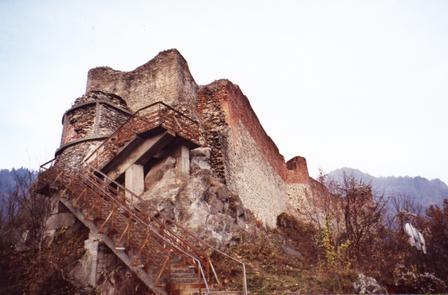
    (Arefu Valley, ROMANIA) -- Dracula’s Castle loomed 1,500 feet above the Arefu Valley where I stood. This is no storybook land, but a region roamed by the real 15th century Count Vlad Tepes Dracula upon whom Bram Stoker based his famous novel, “Dracula.”
    This was my third trip to Eastern Europe, the land of my forebears. I had just descended from the Transylvanian Alps, where lay the roots of the maternal side of my heritage. Beyond Transylvania now, I was about to ascend to the castle set on a rocky Carpathian ridge, 120 miles northwest of Bucharest. It was a last minute impulse on the final day of the World Dracula Congress.
    Seeking to jump start its tourism industry, the Romanian government invited 300 writers, academics and entrepreneurs to the congress, which included a first-ever tour of Dracula landmarks. Forty had come on this tour to see the Castle of Arges, named for the river that flows freely at the mountain’s base.
    My wife, Teresa, walked me to the trail head and insisted I take the blanket she carried from the bus. Others in the group were caught up in a photographic frenzy, too busy to notice my departure.
    The air smelled of rain. As a mountaineer, I had spent many cold nights sleeping on icy cliffs. A night of wind and rain in June wouldn’t kill me. We didn’t know if overnighting in the castle was legal, and surely weren’t about to ask our inflexible escorts. Still set in Communist ways, they had one answer for any request beyond protocol: “Impossible.” Teresa, pregnant with my first son, Mason, stayed with the others who would spend the night in village homes.
    The clouds grew darker and the sun dropped behind the peaks. I shot through the black forest on the very route the Boyars used to haul brick, stone and mortar up the mountainside. Count Dracul had captured in the Boyars in 1457 after they had killed his brother. They were marched from Targoviste and sentenced to build the castle within two years or die. True to his word, those who succeeded were set free, others had already died from sickness or overwork.
    The trail led to hundreds of steps winding upward through the trees. I moved quickly, taking three steps at a time, energized by the fear that one of the escorts would yell for me to stop or chase me down. But it was quiet, save for my steps gaining rhythm, the same upward motion that had trained me for more serious ascents.
    It was an easy trek without a heavy load. I wasn’t exactly equipped for a night on a mountain. I had a loaf of bread, two bananas, two beers and a pack of matches, all of which I would have traded later for a flashlight.
    The unmistakable roar of the bus engine left me to ponder. I was alone in the forest, deep in Romania, a long haul from my native Arizona. I had no idea where the bus was going. Experience traveling the Romanian countryside convinced me the villagers below probably did not speak English, and public transportation didn’t reach them. I was slated to meet Teresa in Bucharest the next evening. That was tomorrow’s problem.
    A uniformed figure stood a hundred steps above me, with an assault weapon and radio on hand. Perhaps he was guarding the castle, I thought, climbing toward him with my eyes cast down. Passing him, I pointed to the castle, saying “Dracula”. He smiled and said nothing. I realized he was guarding the rear flank of the hydro-electric plant hidden in the limestone canyon below.
    Breaking through the trees, sweat dripping, I was atop the ridge in 30 minutes in full view of the castle and the road below. The bus was parked a few miles further up the canyon. I waved my arms. I could see everyone, but like Dracula’s reflection, no one could see me. I was in the 15th century now, thousands of miles from home, in an old fortress high on a mountain, home of “Vlad the Impaler”, killer of thousands.
    Romanians consider him a national hero for his success in fighting off the Turks. He is most notorious for impaling invaders on wooden stakes and leaving their bodies to rot at public roadsides. ! History shows more than 10,000 Turks were impaled and displayed in nearby Targoviste. Many Romanians take offense at the West’s fascination with the count and the vampire icon he inspired.
    The belief in vampirism is a modern day fear in many Romanian villages. In 1960 Boston College Professor Raymond McNally, co-author of “In Search of Dracula”, witnessed villagers in Rudne, near the Borgo Pass, plunging a wooden stake through the heart of an 18-year-old girl who had committed suicide. Other village practices to keep the dead supine include putting coins on the corpse’s eyelids, nailing heads to coffins, slitting the feet to prevent walking, and tying the hands to the feet.
    The first Romanian translation of Stoker’s novel appeared just six years ago. Only now is the government ready to cash in on its fame as the land of Dracula, a move that sparked plans for a second conference in Los Angeles in 1997 — the hundred year celebration of Stoker’s novel.
    Dracula’s castle is in ruins, although its layout is still obvious with its long corridors, archways and large rooms. It covers no more than 8,000 square feet, and at one time had two stories and a dungeon. I ran through the structure searching for a place to sleep. Lizards, millipedes and slugs crawled around, bringing to mind Renfield, Dracula’s slave in Stoker’s novel, who feasted on night creatures.
    A stairway led to a wooden planked bridge where limestone cliffs fell away thousands of feet on both sides. Steep steps climbed upward and disappeared in the castle walls.
    By 7:30 p.m. it was nearly dark and raining. I sat on the cliff below the bridge waiting for the rain to stop. When it did, the wind whipped. I was shivering. I scoured the steep hillside for firewood. The work warmed me until I was pelted again by rain. Running to the bridge, I flung the blanket across its railings to create a roof. I needed something to weight the blanket. I clawed at the castle floor for rocks that were caked in hardened dirt. Blood oozed from my scraped knuckles seeping into the dirt; appropriate to the setting. Bat silhouettes spotted the sky, which was no surprise in a land of limestone. Romania has an estimated 11,000 limestone caves.
    I noticed an intact archway leading to a 15-foot deep pit. Its wall stretched an additional 30 feet above me. This was part of the very tower from which the count’s wife jumped when the Turks invaded the castle. According to some historians, the Turks had her impaled at the castle entrance.
    The count reportedly escaped by riding a horse with its shoes on backwards, fooling the Turks that he had just entered the castle, rather than left.
    The night turns black. Wolves far and near begin to howl. Bears and wolves commonly enter the fortress at night, according to the conference escorts. I am stuck until dawn. My mind races. I imagine powerful hungry beasts roaming through the fortress. I contemplate my escape should any such creatures venture onto the catwalk leading to my small encampment under the arch. The bridge is the only way out, unless I jump into the walled pit behind me.
    At 3 a.m. the wind is ferocious. My only protection is the blanket I was reluctant to take the evening before. Firewood is low. I have no flashlight. I have no choice but to force my way through the darkness and search for more wood. Fighting the wind, wrapped tightly in my blanket, I walk on broken stones through a high walled corridor leading to the forest. Around a bend, the moon appears and lights my path.
    The moonlight raises my spirits. The wolves call. The wind catches my blanket, now a cape billowing in the wind. Shadows dance before me. I’m lost in the moment. I see myself from a distance. A lone figure doused in moonlight standing at the entrance of his cliff side castle. This is the spirit of Dracula.
    I run through the wind and easily find a new load of wood. My movements are passionate and free. The activity is invigorating. It’s a magical event to be rushing through the woods and castle walls, alone, at night, with the wind and the wolves on my side.
    I sit by the fire listening to the wolves calling, taking in the final hours of a night in the 15th century.
    At 6:30 a.m. I disappear into forest. The morning light brings warmth and comfort and takes the magic away. I can easily see through the trees and follow the steps back to the main road. I stand atop the stairs as two armed guards walk up towards me. I smile and nod as they pass. They look right through me.
    As told by David Lengyel to Teresa Lengyel, co-founders of Venture Up Travel and Team Building Events. www.ventureup.com
    #dracula #travel #Romania #Transylvania #castle #venture up #teambuilding #events #Halloween #countvladtepesdracul